Here’s a more natural, less polished-by-AI version with a stronger conversational flow:
We’ve all seen the ads.
A Range Rover, a blacked-out BMW, maybe a Porsche, splashed across your feed with some caption suggesting you could win it for the price of a coffee. It’s tempting. Of course it is. A few quid for a shot at a £60,000 car? On the surface, it sounds like a no-brainer.
But what’s actually going on?
Well, the truth is somewhere in the middle.
Yes, People Really Do Win
Let’s get this out of the way first: genuine winners do exist.
Plenty of UK car competition companies are legitimate. They livestream draws, post winner videos, show handovers, and you can see real people walking away with real cars. So no, it’s not automatically a scam just because the prize looks too good to be true.
But the better question isn’t “does anyone win?”
It’s “how likely am I to win?”
And that’s where things get a bit less exciting.
The Odds Are Still Tiny
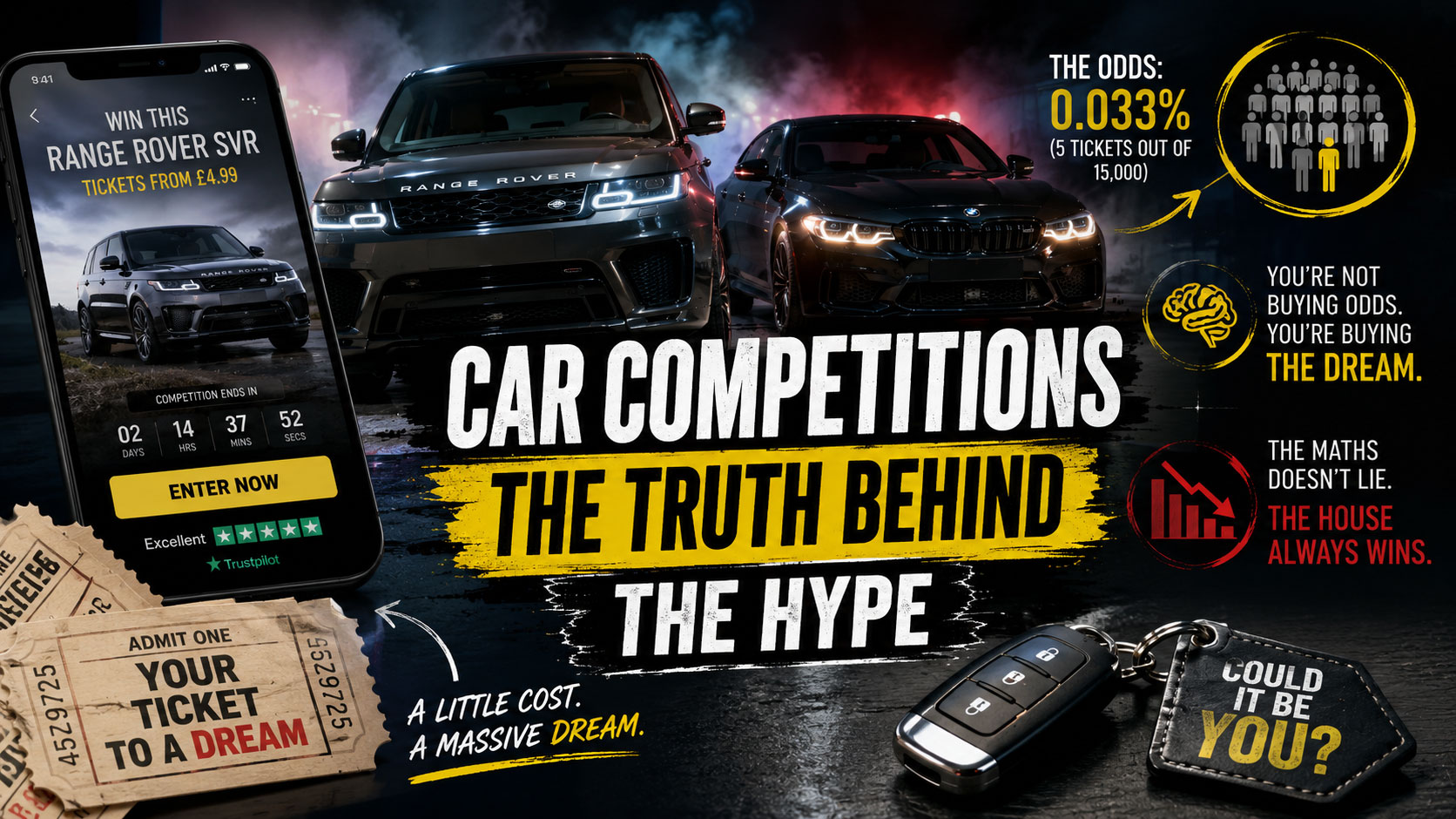
Most competitions have a fixed number of tickets. Let’s say there are 15,000 tickets available and you buy five.
That gives you a chance of around 0.033%.
Now, compared with something like the National Lottery, that might sound pretty decent. And that’s exactly how these companies want you to think about it.
The odds are often framed in a way that makes them feel much better than they really are. Yes, 15,000 entries sounds more manageable than millions. But you’re still one person in a very big crowd.
Why It Feels So Tempting
The problem is that most of us don’t naturally think in percentages.
You don’t see a £5 ticket and immediately calculate expected value. You see the car. You imagine driving it. You picture telling your mates, posting the photo, picking it up, maybe even selling it and banking the cash.
That’s the bit you’re really paying for.
The excitement. The daydream. The little “what if?” moment.
And to be fair, there’s nothing wrong with that, as long as you understand it for what it is.
The Maths Is Not on Your Side
From a purely mathematical point of view, most of these competitions are poor value.
That doesn’t mean nobody wins. It means that, over time, the average player loses money. If you entered the same type of competition again and again, the most likely outcome is that you’d spend far more than you ever got back.
A £5 ticket with a tiny chance of winning a huge prize might feel worth a go. But on paper, it usually doesn’t stack up.
That’s not really the point for most people, though. They’re not buying a sound financial investment. They’re buying a bit of hope and entertainment.
The Danger Is the Repeat Spend
One ticket here and there probably isn’t going to ruin anyone.
The issue is when it becomes a habit.
A lot of these sites are designed to keep you coming back. Bundle offers, countdown timers, instant wins, loyalty points, VIP draws, “limited tickets remaining” messages — it all creates urgency.
Before you know it, £10 here and £20 there turns into a regular weekly spend.
Spend £20 a week for a year and you’re over £1,000 in. That’s the part people often don’t notice until they look back.
Are Some Competitions Better Than Others?
Sometimes, yes.
If you are going to enter, it pays to be selective. The most popular prizes, like Range Rovers, BMWs, Audis and Porsches, usually attract the biggest crowds.
More niche prizes can sometimes offer better odds. A modified van, a project car, a specialist performance car, or something that appeals to a smaller audience may not get as many entries.
That doesn’t make it easy to win. It just means you might be competing against fewer people.
Higher-priced tickets can also reduce the number of entrants, although you obviously risk more each time you play. Smaller sites may offer better odds too, but you should always check that they’re properly run and transparent before spending anything.
Buying More Tickets Helps, But Only So Much
Buying more tickets does improve your chances. That part is true.
But it’s easy to overestimate how much it helps.
If a competition has 20,000 tickets, buying one gives you a 0.005% chance. Buying 100 gives you a 0.5% chance.
That’s a big improvement in one sense, but you’re still far more likely to lose than win.
This is where people can get carried away. They think they’re increasing their odds massively, but in reality they’re often just spending more money on a still-unlikely outcome.
These Sites Know Exactly What They’re Doing
Car competition sites are very good at keeping people engaged.
The timers, the alerts, the “nearly sold out” messages, the winner stories, the loyalty rewards — none of that is accidental. It’s all there to keep the excitement high and make you act quickly.
That doesn’t make the companies dishonest. It just means they understand human behaviour very well.
And if you’re not careful, the emotion can take over before the sensible part of your brain gets a say.
So, Should You Enter?
That depends on how you look at it.
If you treat it as a bit of fun, set a limit, and only spend money you’re genuinely happy to lose, then fair enough. Someone has to win, and it might be you.
But if you’re entering because you think it’s a realistic way to get a dream car, clear debt, change your life, or beat the odds, you’re probably setting yourself up for disappointment.
These competitions aren’t usually scams. They’re probability businesses dressed up as lifestyle opportunities.
The car does go to someone. But the company wins far more reliably than any individual player ever will.
So enter if you want to. Enjoy the excitement. Have the daydream.
Just don’t mistake a slim chance for a smart plan.